

In today’s digital-first world, your small business needs more than just a storefront and a friendly smile to attract customers. It needs a powerful online presence, and that’s where Search Engine Optimization (SEO) comes into play.
For local businesses, mastering SEO isn’t just an option; it’s a strategic imperative for survival and growth against larger competitors.
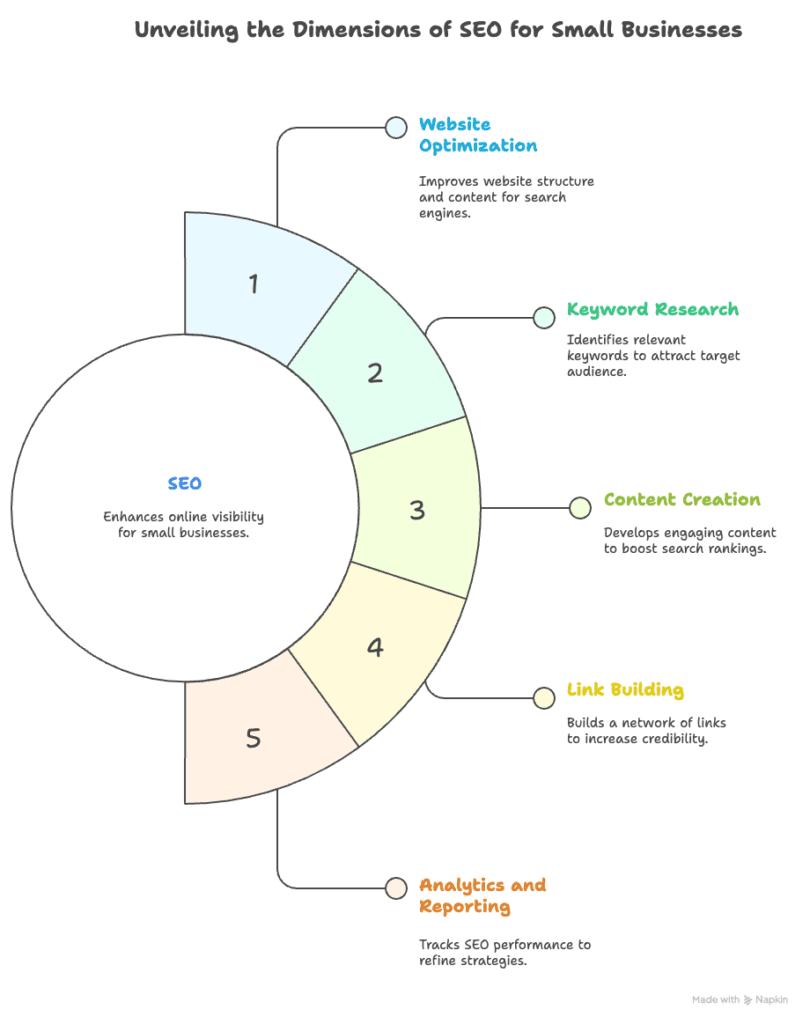
Why SEO Matters for Small Businesses
Imagine a world where your ideal customers are actively searching for the products or services you offer, and your business consistently appears at the top of their search results. That’s the power of effective SEO, and it’s transformative for small enterprises.
1.1. What is SEO and Why is it Crucial for Small Businesses?
Understanding Search Engine Optimization (SEO)
SEO is the practice of increasing the quantity and quality of traffic to your website through organic search engine results. It’s about making your website more visible to people who are looking for solutions that you provide, without paying for ad space.
Think of it as enhancing your shop window so that it catches the eye of passersby, but in the vast digital marketplace.
The Power of Organic Traffic for Customer Acquisition
Organic traffic, meaning visitors who find your site through unpaid search results, is often considered the most valuable. These users are typically actively seeking information or products, making them highly qualified leads.
For small businesses, this translates into a sustainable stream of potential customers who are already interested in what you have to offer, reducing reliance on expensive advertising.
Why Small Businesses Can’t Afford to Ignore SEO
In a world where 97% of consumers use the internet to find local businesses, neglecting SEO means leaving money on the table. The importance of SEO for small businesses cannot be overstated. It’s the engine that drives organic traffic small business growth and helps you build a strong online presence for local businesses without breaking the bank.
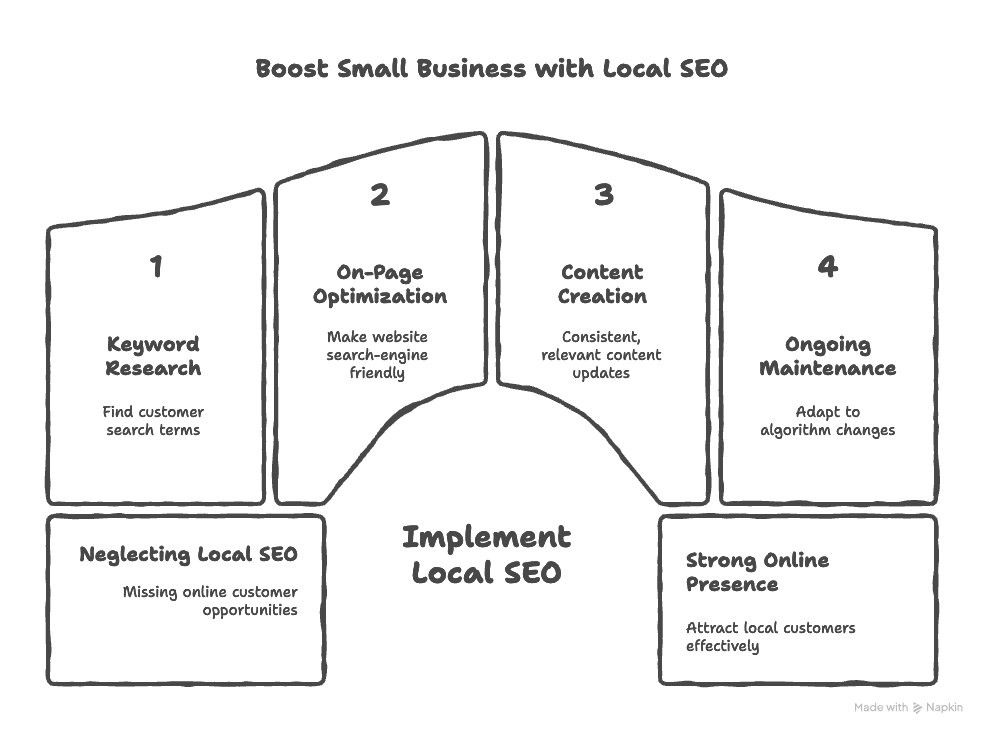
Bridging the Gap with Larger Competitors in Local Markets
While national chains have massive marketing budgets, small businesses have a unique advantage: locality. A targeted local SEO strategy allows you to compete fiercely in your specific geographic area, often outranking larger businesses that don’t optimize for local search.
This is a critical aspect of digital marketing for small businesses that truly levels the playing field.
1.2. Common SEO Myths and Realities for Local Companies
Let’s debunk some common misconceptions that often deter small business owners from embracing SEO.
- Myth: SEO is too expensive or complex for small budgets. * Reality: While professional SEO services can be an investment, there are countless affordable SEO for small
businesses strategies and free tools available.
Many foundational tasks can be tackled in-house, making DIY SEO small business guide resources invaluable. You’d be surprised at how much you can achieve without a massive budget. - Myth: Only large, national companies benefit from SEO. Reality: This couldn’t be further from the truth. Local SEO provides a significant competitive edge specifically for small businesses. When someone searches for “plumber near me,” Google prioritizes local businesses, giving you a golden opportunity to shine right in your community.
What is local SEO for small businesses? It’s your ticket to being found by customers right outside your door! - Myth: SEO is a one-time setup and you’re done.
Reality: SEO is an ongoing process. Search engine algorithms constantly evolve, competitors emerge, and user behavior shifts. Ongoing maintenance, adaptation, and consistent content creation are key to sustained visibility.
If you’re wondering how long until SEO works for small business? It’s not an overnight fix; expect to see significant results typically within 3-6 months, with continuous improvement thereafter.
Foundational SEO Strategies for Small Businesses
Before you can dominate your local market, you need a solid
foundation. These are the core elements every small business website needs to be search-engine friendly.
2.1. Keyword Research: Finding What Your Customers Search For
Understanding what your potential customers type into search engines is the bedrock of any successful SEO campaign. This is where your keyword research for local businesses truly begins.
- Understanding User Intent (Navigational, Informational, Transactional): Is a user trying to find a specific website (navigational), learn something (informational), or buy something (transactional)? Tailoring your content to match this intent is crucial.
- Focusing on Long-Tail Keywords relevant to your niche: Instead of just “bakery,” think “best gluten-free bakery in [city name].” These longer, more specific phrases have less competition and often indicate higher purchase intent.
- Identifying Local Keywords (e.g., “plumber near me,” “bakery in [city]”): These are critical for attracting local customers. Always include your service area in your keyword strategy.
- Tools for Keyword Research (Google Keyword Planner, SEMrush, Ahrefs, Ubersuggest): Even on a budget, tools like Google Keyword Planner are free and invaluable. For more robust analysis, consider trial versions of SEMrush or Ubersuggest. These are some of the best free SEO tools for small businesses to get started.
- Mapping Keywords to Your Website’s Services and Products: Ensure each service or product page on your site targets specific keywords, signaling relevance to search engines. This is a key business SEO tips to make sure your content is focused.
2.2. On-Page Optimization: Making Your Website Search-Engine Friendly
Once you know your keywords, it’s time to implement them on your website. This is on-page SEO for small business websites at its finest.
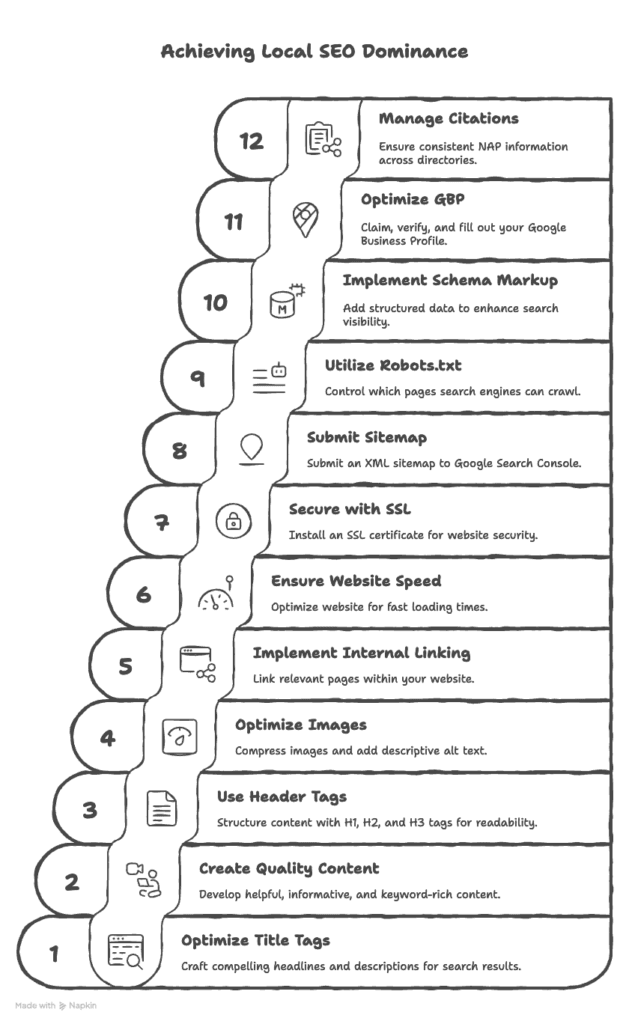
- Optimizing Title Tags and Meta Descriptions for click-through rates: These are the headlines and descriptions users see in search results. Make them compelling, include your primary keyword, and clearly communicate what the page is about.
- Crafting Engaging, High-Quality, and Keyword-Rich Content: Your content should be helpful, informative, and naturally incorporate your target keywords. Quality always trumps quantity.
- Effective Use of Header Tags (H1, H2, H3) for structure and readability: Use H1 for your main title (one per page), and H2, H3 for subheadings to break up content and highlight important topics for both users and search engines.
- Image Optimization (Alt Text, Descriptive File Names,
Compression): Describe your images using relevant keywords in their alt text and file names. Compress images to ensure fast loading times – crucial for user experience and SEO. - Internal Linking Best Practices to distribute link equity: Link relevant pages within your own website using descriptive anchor text. This helps search engines understand your site’s structure and passes authority between pages. All these elements contribute to robust website optimization small business efforts.
2.3. Technical SEO Basics for Small Business Websites
Technical SEO focuses on the backend of your website to help search engines crawl and index it more effectively. Don’t let the word “technical” intimidate you; these are foundational for any small business SEO strategy.
- Website Speed and Mobile-Friendliness (Core Web Vitals): Google prioritizes fast-loading, mobile-responsive websites. Use Google’s PageSpeed Insights to check your site’s performance. Optimizing for mobile SEO for local businesses is non-negotiable, as most local searches happen on smartphones.
- Ensuring an SSL Certificate (HTTPS) for security and ranking: An SSL certificate encrypts data, securing your website. Google favors secure sites, so ensure your URL starts with `https://`.
- Setting Up and Submitting XML Sitemaps: An XML sitemap is a list of all the important pages on your website, guiding search engine bots through your site. Submit it via Google Search Console. * Utilizing Robots.txt for crawl control: This file tells search engine crawlers which pages or files they can or cannot request from your site. Use it wisely to prevent unimportant pages from being indexed.
- Implementing Structured Data Markup (Schema) for local businesses: Schema markup provides search engines with specific information about your business (e.g., address, phone number, ratings, services). This can lead to rich snippets in search results, improving visibility and helping to improve small business search ranking.
Local SEO: Dominating Your Geographic Market
This is where small businesses truly shine. Local SEO is all about being found by customers in your immediate vicinity, turning online searches into real-world visits. It’s an essential part of any successful local search engine optimization for businesses campaign.
3.1. Google Business Profile (GBP) Optimization
Your Google Business Profile (formerly Google My Business) is arguably the most important local SEO tool. It’s how you appear in Google Maps and the local “3-pack” of search results.
- Claiming, Verifying, and Completely Filling Out Your GBP Listing: This is step one. Provide accurate, up-to-date information for every field. This is your comprehensive Google My Business optimization guide.
- Adding Accurate Business Information (Hours, Services, Photos, Description): Ensure NAP (Name, Address, Phone) consistency. Upload high-quality photos of your business, products, and team. A compelling business description can also set you apart.
- Utilizing GBP Posts for Updates, Offers, and Events: Use this feature to announce sales, new products, or events. These posts appear on your profile and can drive engagement.
- Actively Responding to Customer Questions and Reviews: Show potential customers you’re engaged and care about their feedback. Prompt and professional responses build trust and improve your ranking. This is a crucial element of your local SEO checklist for small business.
3.2. Local Citations and Directory Listings
Citations are online mentions of your business’s NAP information. Consistency is king here for strong local SEO ranking factors.
- Understanding NAP (Name, Address, Phone Number) Consistency Across All Listings: Inconsistent NAP data confuses search engines and erodes trust. Ensure your business name, address, and phone number are identical across every online listing.
- Submitting to Key Local Directories (Yelp, Yellow Pages, Industry-Specific Sites): Manually submit your business information to popular directories. Don’t forget industry-specific ones (e.g., Angi for home services).
- Managing Data Aggregators (e.g., Factual, Infogroup): These companies feed business data to hundreds of smaller directories. Ensuring your information is correct with them can automate broad consistency.
- Cleaning Up Inconsistent or Duplicate Listings: Periodically audit your citations. Identify and correct any discrepancies or merge duplicate listings to strengthen your local SEO.
3.3. Generating Local Reviews and Testimonials
Reviews are social proof that builds trust and boosts your local search rankings. This is part of your online review management small business strategy.
- Strategies for Encouraging Customers to Leave Reviews (e.g., follow-up emails, in-store signage): Make it easy for customers. A polite request at the point of sale, a link in a follow-up email, or a QR code on your business card can work wonders.
- Responding Professionally to All Reviews (Positive and Negative): Always thank customers for positive reviews. For negative ones, respond courteously, offer to resolve the issue offline, and show that you value feedback. Your handling of negative reviews can often be more impactful than the positive ones.
- Showcasing Positive Testimonials prominently on your website and marketing materials: Don’t let great reviews just sit on Google. Feature them on your website, social media, and in your marketing collateral to amplify their impact.
Content and Link Building for Small Business SEO Growth
Beyond technical SEO fixes, quality content and strong backlinks are vital for increasing your domain authority and attracting a wider audience.
4.1. Content Marketing That Attracts Local Customers
Content isn’t just for big brands. For small business SEO, localized content can be incredibly powerful.
- Blogging for Local SEO (Local Guides, Event Recaps, FAQs specific to your area): Create blog posts about local events, “best things to do in [your city],” or address common questions from local customers. This builds your reputation as a community expert. This helps shape your content strategy for small businesses.
- Creating Service/Product Pages Optimized for Local Search Intent: Each service or product you offer should have its own dedicated page, optimized with local keywords and detailed
descriptions. - Developing Engaging Multimedia Content (Video, Infographics related to local topics): Videos showcasing your business, local neighborhood, or client testimonials can be highly engaging. Infographics about local market trends can also attract attention. * Guest Blogging on Complementary Local Business Websites or Publications: Write articles for non-competing local businesses (e.g., a bakery writing for a local coffee shop’s blog). This exposes your brand to new local audiences and generates valuable backlinks.
4.2. Building Quality Backlinks for Authority
Backlinks (links from other websites to yours) are like votes of confidence. The more high-quality, relevant backlinks you have, the more authority Google perceives your site to have. This is the essence of off-page SEO for small businesses.
- Understanding the Importance of Backlinks for Domain
Authority: Backlinks signal to search engines that your site is a credible and authoritative source of information. This significantly impacts your ranking potential. - Local Outreach Strategies (Partnerships, Sponsorships, Local Event Participation): Sponsor a local sports team, partner with a charity, or participate in community events. These activities can earn you natural mentions and links from local news sites or organization pages. This is smart backlink building for small business. * Broken Link Building Opportunities within your niche: Find broken links on reputable websites in your industry. Reach out to the webmaster, suggest your relevant content as a replacement, and potentially earn a backlink.
- Competitor Backlink Analysis to find new link prospects: Tools like Ahrefs or SEMrush allow you to see where your competitors are getting their backlinks. This can reveal valuable opportunities for your own outreach efforts.
Measuring Success and Continuous Improvement
SEO isn’t a “set it and forget it” task. To ensure your efforts are paying off and to stay ahead, you need to constantly monitor, analyze, and adapt.
5.1. Essential SEO Tools for Small Businesses
These tools are your eyes and ears in the digital landscape, offering insights into your performance and areas for improvement. Embracing them is one of the best SEO practices for local businesses.
- Google Analytics for website traffic and user behavior insights: Track visitors, bounce rates, time on site, conversion rates, and more. Understand how users interact with your website. * Google Search Console for technical SEO, keyword performance, and errors: This free tool tells you how Google sees your site, identifying indexing issues, top-performing keywords, and crawl errors.
- Google Business Profile Insights for local visibility metrics: See how many people viewed your profile, requested directions, or called your business directly from GBP.
- Local SEO Ranking Trackers (e.g., BrightLocal, Moz Local): These specialized tools help you monitor your local rankings for specific keywords and track your performance in the local pack.
5.2. Tracking Your SEO Performance and Key Performance Indicators (KPIs)
Knowing what to measure is crucial to understanding the impact of your SEO efforts. This helps you understand the true SEO benefits for small businesses.
- Monitoring Organic Traffic and Conversion Rates: Are more people finding you through search? Are they then taking desired actions (e.g., making a purchase, filling out a form, calling)? This answers the question, is SEO effective for small businesses? * Tracking Keyword Rankings (Local and General): Are your target keywords moving up in the search results? Are you appearing in the local 3-pack?
- Analyzing User Engagement Metrics (Bounce Rate, Time on Site): High bounce rates or low time on site can indicate content or user experience issues that need addressing.
- Measuring Local Visibility and Map Pack Rankings: How often do you appear in Google Maps and the local search results for relevant queries? This is a strong indicator of local success.
5.3. Adapting to Algorithm Changes and Future-Proofing Your Strategy
The SEO landscape is dynamic. What works today might not work tomorrow, making continuous learning vital.
- Staying Updated with SEO News, Trends, and Google Algorithm Updates: Follow reputable SEO blogs and news sources to stay informed about changes that could impact your rankings.
- The Importance of User Experience (UX) and E-E-A-T (Experience, Expertise, Authoritativeness, Trustworthiness): Google increasingly prioritizes websites that offer an excellent user experience and demonstrate E-E-A-T. Focus on providing real value and establishing your authority.
- Embracing Voice Search Optimization for local queries: With the rise of smart speakers and mobile assistants, optimizing for natural language, conversational queries (e.g., “Where’s the best pizza near me?”) is becoming increasingly important.
- Considering AI’s Impact on Search and Content Creation: AI is already influencing search results and content generation.
Understanding how to leverage AI tools responsibly while maintaining high-quality, human-centric content will be key to future-proofing your strategy. As for how much does SEO cost for a small business? It’s not just a one-time fee; it’s an ongoing investment in expertise, tools, and content that adapts to this ever-changing digital environment.
By following this comprehensive guide, small businesses can build a robust online presence, attract more local customers, and truly dominate their geographic market. SEO is an ongoing journey, but one that promises significant returns for those who commit to it.
